I see founders make the same mistake every week. They look for a top UI UX design agency to make their product look modern, but they ignore the underlying friction. Beautiful screens cannot fix broken product thinking. If your onboarding is complex or your core loop is weak, users will still churn. Good design is about clarity and removing cognitive load. In this guide, I will show you how to look past the surface and find partners who actually solve business problems, simplify decisions, and are grounded in real user behavior.
Quick answer
Finding the right top UI UX design agency requires evaluating their strategic depth rather than just looking at their visual portfolio. Here is a quick breakdown of the 10 best partners for product-led businesses and startups today.
The state of product design in 2026
The baseline for good digital design has shifted dramatically. Users no longer tolerate steep learning curves. They expect immediate value, zero friction, and interfaces that anticipate their needs.
This shift is largely driven by the rapid integration of artificial intelligence into everyday tools. A 2026 study by the Nielsen Norman Group indicates that user tolerance for complex navigation has dropped by 35% compared to just two years ago. Users expect systems to do the heavy lifting.
If your product forces users to configure settings for ten minutes before seeing value, you have already lost them. We see teams overcomplicate onboarding constantly. They try to teach the user every feature at once. This cognitive overload directly causes low activation rates.
Design in 2026 is no longer about arranging buttons on a screen. It is about systems thinking. It is about designing for non-deterministic AI outcomes, managing complex data structures, and creating intuitive paths to activation. You need a partner who understands these mechanics.
What exactly should you expect from a top UI UX design agency today?
Most founders hire designers to execute a roadmap. This is a flawed approach. A strong design partner should challenge your roadmap. They should ask hard questions about user motivation and business constraints before they ever open a design file.
If a firm agrees to design exactly what you ask for without questioning the underlying assumptions, you are working with order-takers. You do not need order-takers. You need strategic thinkers.
Here is what you should expect from a mature design partner.
- Focus on business metrics: They should tie their design decisions to activation, retention, and churn.
- Rapid validation: They should prioritize testing concepts with real users before writing a single line of code.
- Technical feasibility: They must understand the constraints of your engineering team. A design is useless if it takes six months to build.
- Systematic thinking: They should build scalable design systems that allow your internal team to move faster after the engagement ends.
Recent 2025 data from McKinsey & Company reinforces this. Companies that integrate strategic design thinking at the executive level see a 32% higher return on product investments. Design is a business lever, not just a coat of paint.
How did we evaluate every top UI UX design agency for this review?
Evaluating a design partner is difficult because case studies often hide the messy reality of product development. A polished case study shows the final result, but it rarely shows the discarded ideas, the technical compromises, or the actual impact on metrics.
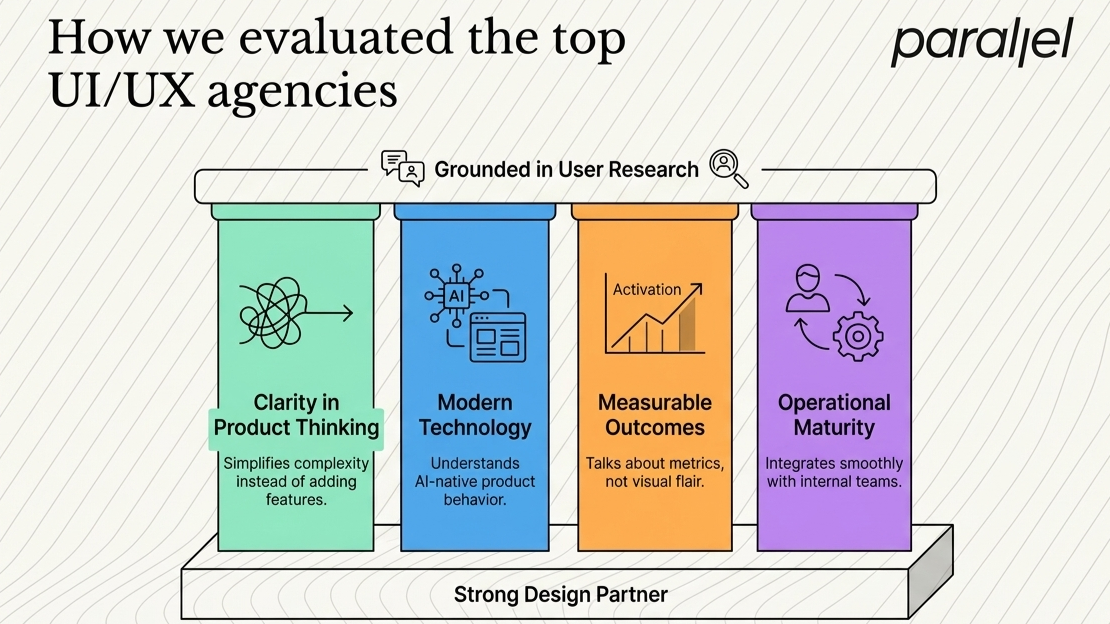
At ParallelHQ, we have audited hundreds of products. We have seen what works and what fails. We used that experience to build a strict evaluation criteria for this list.
We focused on the following pillars.
- Clarity in product thinking: Do they simplify complex problems or do they add unnecessary features?
- Experience with modern tech: Do they understand how to design for AI natively, or are they just adding chatbot widgets?
- Measurable outcomes: Do they talk about visual flair or do they talk about improving onboarding metrics?
- Operational maturity: Do they integrate well with internal product and engineering teams?
We also looked at their ability to conduct meaningful user research. Without research, design is just guessing. The firms on this list have proven methodologies for extracting real insights from users.
Who is the top UI UX design agency for your specific product needs?
Finding the right fit depends entirely on your current stage, your budget, and the specific problem you are trying to solve. An agency that excels at consumer branding might fail completely at designing a complex B2B SaaS dashboard.
Here is a detailed breakdown of the ten best options available right now.
1) ParallelHQ
We built ParallelHQ because we saw too many startups wasting time and money on design work that did not move the needle. We are a product design and strategy partner focused entirely on clarity. We work closely with founders and PMs at early-stage and growth-stage companies.
Our approach is grounded in real user behavior. We do not believe in lengthy, bloated design phases. We believe in rapid iteration, clear decision-making, and getting functional concepts in front of users as quickly as possible.
We specialize in solving complex product experiences. If your software has a steep learning curve or weak activation, we help simplify it. We frequently use design sprints to compress months of debate into a single week of focused problem-solving.
For teams building the next generation of software, our AI UX design capabilities ensure that artificial intelligence is integrated naturally into the user flow, rather than feeling like a bolted-on gimmick. We also provide a comprehensive UX audit to identify exact friction points in your current product.
2) MetaLab
MetaLab is famous for creating the initial interfaces for massive consumer products like Slack and Tinder. They are exceptionally good at visual polish and creating products that feel distinct in crowded markets.
They have a massive team and the capability to handle extremely large, high-budget projects. If you are a well-funded startup aiming for a massive consumer launch and need top-tier visual positioning, they are a strong choice.
However, their engagements are typically very expensive and structured for scale. Early-stage teams dealing with rapid pivots might find their process too heavy. If you are looking for a more agile partner focused on B2B complexity, you might want to review a MetaLab alternative.
3) IDEO
IDEO essentially invented modern design thinking. They are a global powerhouse known for deep foundational research and solving massive, systemic problems. They excel when the problem is undefined and requires extensive ethnographic research.
Their approach is highly academic and rigorous. If you are trying to invent a completely new category of product that blends physical hardware with digital software, IDEO has the pedigree to handle it.
The downside is speed and cost. Their exploratory phases can take months before resulting in tangible UI screens. For software startups that need to ship fast and iterate based on live data, this pace can be a mismatch. You can explore an IDEO alternative if you need faster digital execution.
4) Clay
Clay is a UI/UX agency that blends high-end brand identity with digital product design. They are very strong at creating cohesive experiences that transition smoothly from a marketing website into the actual software product.
They have a distinct, modern aesthetic. If your product relies heavily on brand perception and you need a website redesign that seamlessly matches your app interface, Clay does this exceptionally well.
Their focus tends to lean heavily toward the visual and brand side of the spectrum. For deeply complex data visualization or highly technical enterprise tools, their brand-first approach might require adjustment. See our thoughts on finding a Clay alternative for highly technical SaaS products.
5) Frog Design
Frog is a massive global consultancy with decades of history. Like IDEO, they excel in environments where the physical and digital worlds meet. They are experts at connected ecosystems, industrial design, and service design at an enterprise scale.
They bring a massive amount of resources to any project. If you are a Fortune 500 company looking to overhaul your entire customer experience across multiple touchpoints, Frog has the infrastructure to support that.
For a lean software startup, Frog is likely overkill. Their processes are built for enterprise stakeholders and long timelines. Agile teams often seek a Frog design alternative to maintain velocity.
6) Ramotion
Ramotion specializes in working with growing startups. They focus heavily on brand identity, marketing websites, and clean, modern UI design. They have a recognizable aesthetic that feels very much aligned with current tech trends.
They are a great fit for a Seed or Series A company that needs to look incredibly professional quickly. They understand the startup ecosystem and how to package a product for investors and early adopters.
While they are excellent at visual design and branding, teams with deeply complex product mechanics might need a partner more focused on behavioral psychology and UX research. If you need deep product strategy over branding, consider a Ramotion alternative.
7) Work & Co
Work & Co is known for a highly integrated approach where strategy, design, and engineering happen concurrently. They are focused exclusively on digital products and pride themselves on shipping functional software rather than just design concepts.
They are an excellent partner for large brands that need to launch massive digital platforms quickly. Their prototyping speed is impressive, and their technical chops ensure their designs are buildable.
Their model requires intense, daily collaboration from senior client stakeholders. If your internal team does not have the bandwidth to match their pace, the engagement can become challenging. Smaller teams might look for a Work & Co alternative that offers more flexible engagement models.
8) R/GA
R/GA comes from an advertising and marketing background, but they have built a formidable digital product practice. They are brilliant at connecting a brand's narrative with its digital utility.
If your product is consumer-facing and heavily reliant on marketing campaigns, social integration, and brand storytelling, R/GA understands how to connect those dots better than most pure product agencies.
Because of their advertising roots, their product design can sometimes prioritize engagement and brand moments over pure utilitarian efficiency. For strict B2B utility software, teams often explore an R/GA alternative.
9) Huge
Huge is an enterprise-level digital agency. They handle massive digital transformation projects for global brands. They offer everything from UX design to marketing, engineering, and business strategy.
If you are a large corporation looking to completely restructure your digital presence and need a partner capable of handling thousands of pages of information architecture, Huge is built for that scale. They are experts in enterprise software design services.
They are not built for startups. Their overhead, timelines, and team structures are designed to interface with massive corporate departments. Agile product teams generally prefer a Huge alternative for faster execution.
10) Instrument
Instrument focuses on creating digital platforms that are deeply rooted in brand narrative. They work with some of the biggest lifestyle and tech brands in the world, creating digital experiences that feel highly bespoke and engaging.
They excel at digital storytelling. If you are building a product where the emotional connection with the user is the primary differentiator, Instrument creates beautiful, narrative-driven work.
Their approach is highly custom and often relies on complex, bespoke interactions. For utility-driven SaaS products where speed and standard conventions are preferred, a more traditional product partner or an Instrument alternative might be appropriate.
Why do teams fail when working with a top UI UX design agency?
I have stepped in to rescue many failed design engagements. The pattern is almost always the same. The failure rarely comes from a lack of design talent. It comes from a lack of alignment on the core problem.
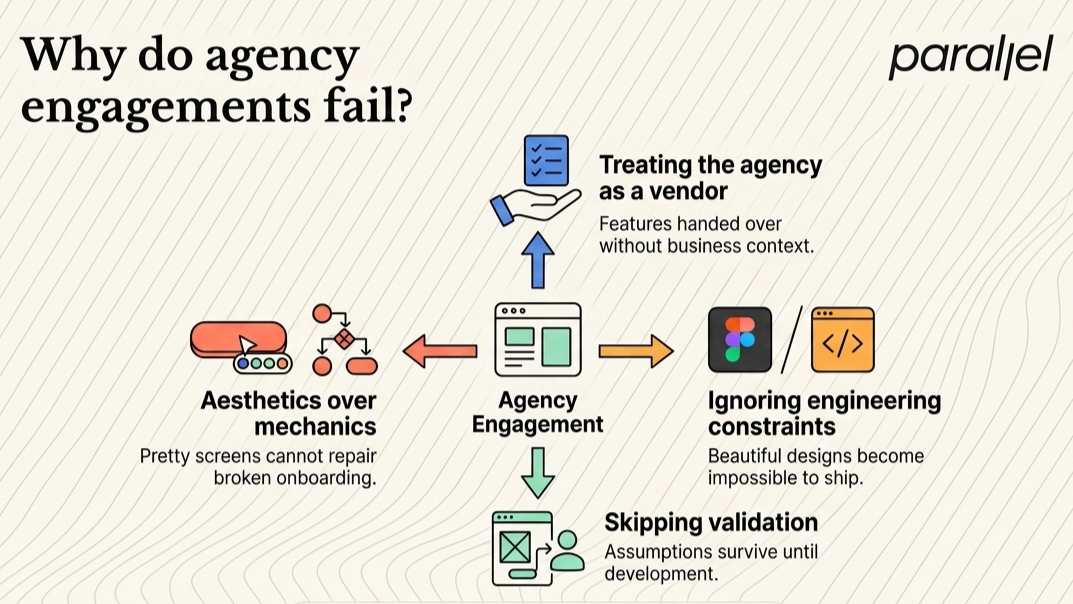
Here is where product decisions go wrong when working with external partners.
Treating the agency as a vendor, not a partner
If you hand an agency a list of features and tell them to make it look nice, you will get a bad outcome. Good design requires context. The design team needs to understand your business model, your technical debt, and your user complaints. You must give them access to your data and your users.
Ignoring engineering constraints
A beautiful Figma file is useless if your engineering team cannot build it within the current sprint cycle. We see agencies design complex, custom UI components without consulting the engineering leads. This creates massive friction during handoff. A strong partner will establish a technical dialogue on day one and build components that align with your existing architecture.
Skipping user validation
Founders often assume they know exactly what the user wants. They push agencies to skip research and go straight to high-fidelity design. According to 2026 data from the Interaction Design Foundation, fixing a UX error after development costs up to 100 times more than fixing it during the prototyping phase. You must test assumptions early.
Focusing on aesthetics over mechanics
We’ve seen teams obsess over border radiuses and color palettes while their core onboarding flow is completely broken. Aesthetics matter for trust, but mechanics matter for retention. If the core loop is confusing, the colors do not matter. We highly recommend starting with a SaaS onboarding teardown before worrying about visual style.
How to measure the success of your design investment
Design is not art. It is a measurable business function. When you invest in product design, you need to track specific metrics to ensure the work is actually moving the needle.
Do not accept "it looks better" as a success metric. Demand quantitative improvement.
Here are the metrics you should be tracking.
- Time to value (TTV): How long does it take a new user to experience the core benefit of your product? Good design reduces this time drastically.
- Activation rate: What percentage of users complete the onboarding sequence? Simplifying the first steps always improves this number.
- Support ticket volume: Are users constantly asking how to perform basic tasks? A successful redesign should significantly lower support requests regarding navigation and basic functionality.
- Task completion rate: Can users successfully navigate your core workflows without dropping off?
If your design partner is not discussing these metrics, they are not focused on your business. They are only focused on their portfolio.
Conclusion
Product development is chaotic. Priorities shift, markets change, and user feedback often invalidates weeks of work. Your design process needs to accommodate this reality.
Heavy, waterfall-style design phases do not work for modern software teams. You need a process that allows for rapid discovery, quick prototyping, and immediate user feedback. This is why we rely heavily on opportunity mapping to prioritize the most impactful work first.
Start by auditing your current state. Understand exactly where users are struggling. Fix the structural issues first, and the aesthetic polish will naturally follow. Clarity will always outlast visual trends.
FAQ
1) What defines a top UI UX design agency in 2026?
A strong partner today is defined by their strategic depth, their ability to design for AI-driven outcomes, and their focus on business metrics like activation and retention. Visual polish is just the baseline requirement.
2) How much does professional UX design cost?
Costs vary wildly based on scope and agency size. A focused sprint or audit might cost between $10k and $25k. A full product redesign with a premium agency can easily range from $75k to $250k+. Always align the budget with the expected business return.
3) How long does a standard product redesign take?
A traditional full redesign can take 3 to 6 months. However, we prefer agile models. By using design sprints, we can often define core mechanics and validate prototypes within a few weeks, allowing engineering to start building sooner.
4) Should we hire in-house or use a top UI UX design agency?
Early-stage teams often benefit from an agency to establish the core product strategy, design system, and foundational architecture quickly. Once the product has market fit, building an in-house team becomes necessary for long-term maintenance and incremental updates.
5) What is the difference between a UX firm and a digital marketing agency?
A marketing agency focuses on customer acquisition, brand awareness, and optimizing marketing funnels. A UX firm focuses on the actual software product, focusing on user retention, task completion, and behavioral psychology within the application.
6) How do we measure the ROI of our design investment?
Track user metrics before and after the engagement. Look for improvements in activation rates, a reduction in time-to-value, lower churn, and a decrease in support tickets related to usability issues.
7) Is my startup too early to hire an external design partner?
If you have not proven your core value proposition manually, it might be too early. However, once you have users but are struggling to retain them due to friction, or you need to raise capital and your current product looks untrustworthy, an external partner is highly valuable.
8) How does ParallelHQ differentiate itself as a top UI UX design agency?
We do not focus on superficial deliverables. We focus entirely on clarity, problem-solving, and practical product thinking. We work directly alongside founders to simplify complex features and ground every design decision in real user behavior and business reality.

check out these related blogs